
Dental Implants vs Dentures: Which Is Better?
If you are trying to decide between dental implants vs dentures, you are not alone. Many adults reach a point where they need to replace missing teeth and want to make the right long-term choice for their comfort, confidence, and oral health. The challenge is that there is no one-size-fits-all answer. What feels like the better option for one person may not be ideal for someone else.
At Miller Center Dental, patients in Livingston often ask whether dentures and dental implants will help them eat better, speak more clearly, and feel more like themselves again. Those are exactly the right questions. Choosing replacement teeth is not just about filling a gap. It is about how your smile works every day, how your gums and jawbone respond over time, and how natural your results feel in real life.
Understanding the Difference Between Dentures and Dental Implants
Dentures are removable replacement teeth that sit on top of the gums. They can replace a few missing teeth or a full arch. Partial dentures are used when some existing teeth remain. Complete dentures are used when all teeth in the upper or lower arch are missing. Traditional dentures, also called conventional dentures, rely on the shape of the gums and jaw for support, and in some cases denture adhesive helps improve hold.
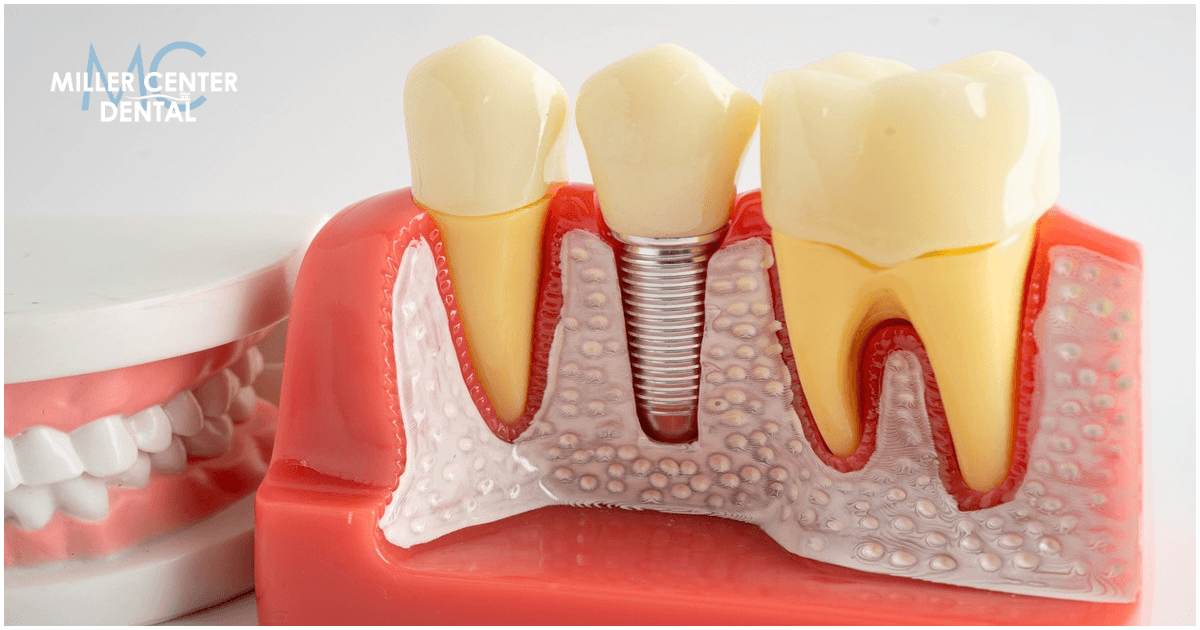
Dental implants are small posts placed surgically into the jawbone to act like artificial tooth roots. Once healed, they can support a crown, a fixed bridge, or full-arch replacement teeth. Because implants are anchored in bone, they tend to feel more stable than removable appliances. For many patients, that stability is the biggest difference in the dental implants vs dentures conversation.
When Traditional Dentures Make Sense
Traditional dentures remain a practical and effective way to replace missing teeth. They have helped generations of denture wearers restore their smile and basic function. If someone has extensive tooth loss, wants a removable solution, or is not ready for surgery, dentures may be the better option.
They also work well in different situations. A person missing one or more teeth may do well with partial dentures. Someone who has lost all teeth in an arch may benefit from complete dentures. In both cases, the goal is to restore appearance, support the lips and cheeks, and improve chewing enough to make daily life easier.
Dentures can also be a good fit for patients whose oral health needs call for a simpler treatment path. If the gums need time to heal after extractions, or if there has been significant bone loss over many years, removable dentures may be part of the treatment plan. They can provide function and a natural appearance without the need for a tooth implant at every missing site.
Where Dentures Can Be Frustrating
Anyone comparing dental implants vs dentures should understand the tradeoffs. Traditional dentures can restore a smile, but they do not act like natural teeth. Because they rest on gum tissue rather than being secured into bone, they may shift during chewing or speaking. Lower dentures in particular can be tricky because the lower jaw typically offers less surface area for support.
That is why some denture wearers avoid certain foods, especially sticky foods or harder textures that require stronger biting force. Even with proper care, dentures may need relining or regular adjustments as the gums and bone change shape. Over time, the fit can loosen. Many patients describe this as a shoe that used to fit well but slowly becomes less secure.
Another issue is bone loss. When teeth are missing, the jawbone no longer receives the stimulation that natural tooth roots provide. As a result, the bone can shrink over time. This affects how dentures fit and can change facial contours. In the dental implants vs dentures discussion, this is one of the most important long-term differences.
Why Many Patients Prefer Dental Implants
Dental implants are designed to replace missing teeth in a way that closely mimics natural teeth. The implant post is placed surgically into the jawbone, where it can fuse with the bone and create a stable foundation. That support gives implants a fixed, secure feel that many patients find closer to their own teeth.
This can improve chewing, speech, and day-to-day confidence. Patients often say they no longer think constantly about whether their teeth will move. They can laugh, talk, and eat without the same level of self-consciousness that sometimes comes with a removable denture. For someone who wants replacement teeth that function more like natural teeth, implants are often the better option.
Implants can be used in several ways. A single tooth implant can replace one missing tooth. Multiple teeth can sometimes be replaced with implant-supported bridges. Full-arch treatment can use several implants to support a complete set of new teeth. If you want to learn more about implant dentistry options, it helps to understand that treatment can be tailored to the amount of tooth loss, bone support, and overall goals.
The Bone Loss Factor Matters More Than Many People Realize
One reason dental implants stand out is their relationship to the jawbone. When implants are placed surgically into the bone, they help transmit pressure during chewing in a way that encourages bone growth and helps prevent bone loss. That support can preserve the shape of the jaw better than traditional dentures alone.
This matters because bone loss is not just a cosmetic issue. It can affect how your bite functions, how your face is supported, and how comfortably dentures fit in the future. A shrinking jawbone can make a removable denture less stable and less predictable. It can also reduce the available bone for future implant placement if treatment is delayed for a long time.
Not every patient has enough jawbone at the start. Some people already have significant bone loss due to long-term tooth loss, gum disease, or aging changes in the mouth. Even then, implants may still be possible depending on the case. A detailed exam and imaging help determine the amount and quality of bone support available.
Implant Supported Dentures Offer a Middle Ground
For many patients, the decision is not really dentures or implants. It is a blend of both. Implant supported dentures combine the coverage of dentures with the stability of implants. Instead of resting only on the gums, the denture attaches to implants placed in the jaw. This can create a much more secure fit and reduce movement.
Implant supported dentures can be removable or fixed depending on the design. Some implant retained dentures snap into place and are removed for cleaning. Others are fixed in place and can only be removed by the dentist. Both approaches aim to improve function, support, and comfort compared with conventional dentures.
This option is especially appealing for people who are tired of adhesive, slipping, or soreness from a removable denture. It can also help improve chewing and make it easier to eat a wider variety of foods. Many patients find that implant dentures give them a more natural looking smile and a more comfortable fit without requiring an individual tooth implant for every missing tooth.
If you are exploring this middle-ground approach, this overview of implant-supported dentures can help you understand how support changes the experience of wearing dentures.
Full-Arch Implants for Extensive Tooth Loss
When an entire upper or lower arch is missing, full-arch treatment may be worth discussing. Some patients are candidates for solutions that use a limited number of implants to support a complete arch of fixed replacement teeth. This can offer greater stability and a more streamlined alternative to a full removable denture.
For example, full-arch All-on-4 treatment can provide a fixed solution for certain patients who want a secure smile and improved function. In the dental implants vs dentures comparison, this type of treatment often appeals to people who want to move away from removable appliances entirely.
That said, suitability depends on several factors, including the condition of the gums, the amount of jawbone, bite forces, and overall health. A careful evaluation matters. At a practice like Miller Center Dental, advanced diagnostics and personalized treatment planning help match the right approach to the right patient rather than forcing everyone into the same category.
Comparing Comfort, Stability, and Daily Life
In practical terms, one of the biggest differences between dentures and dental implants is what everyday life feels like. Traditional dentures are removable. They may be comfortable at first, but comfort can change as the gums and bone shift. They may also require adhesive, especially in the lower jaw where movement is more common.
Implants are fixed in the jawbone, so they generally offer greater stability. That can make a noticeable difference when chewing, speaking, or simply smiling without thinking about your teeth. A secure fit often translates into more freedom at meals and fewer awkward moments in social settings.
There is also the issue of maintenance. Dentures require cleaning outside the mouth and may need relines or regular adjustments over time. Implants also require proper care, but they are maintained more like natural teeth, with brushing, flossing or specialized cleaning tools, and routine dental visits. In both cases, good habits matter. The difference is that implant-supported solutions usually feel less like managing a device and more like caring for part of your smile.
What About Appearance?
Both dentures and dental implants can improve appearance. Modern dentures can be crafted to look natural and restore facial support. For someone who has been living with many missing teeth, that can be a dramatic improvement.
Still, implants often have an edge when patients want results that feel and look closer to natural teeth. Because they are anchored in bone and can emerge through the gums in a more tooth-like way, they tend to create a more seamless effect. This is especially true for a single tooth or a fixed bridge replacing several missing teeth.
In the dental implants vs dentures comparison, appearance is not just about how the teeth look in a mirror. It is also about how they move when you talk, how secure they feel when you laugh, and whether they help you forget you ever had tooth loss in the first place.
Which Option Is Better for Oral Health?
The answer depends on your starting point. If you have healthy existing teeth and only a few missing teeth, preserving what remains is a major priority. Partial dentures may be one route, while implants may be another. If tooth decay or gum disease has already affected the smile more broadly, treatment planning becomes more complex.
Dental implants can support oral health by helping preserve bone and by avoiding the need to place pressure on neighboring teeth in some cases. A fixed bridge, by contrast, may involve support from adjacent teeth depending on the design. Dentures can restore function, but they do not prevent bone loss in the same way implants can.
That said, implants are not automatically best for every patient. The gums must be healthy enough for treatment, and the mouth must be ready for surgery and healing. A thoughtful dentist will look at the whole picture, not just the missing spaces.
Questions That Help You Decide
When patients in Livingston compare dentures and dental implants, a few questions usually bring clarity. Do you want something removable or fixed? Are you hoping to replace a single tooth, multiple teeth, or a full arch? How important is maximum chewing strength to you? Are you comfortable with surgery? How much bone support is available in the jaw?
It also helps to think about your day-to-day life. If the idea of removing your teeth at night feels discouraging, implants may be more appealing. If you want a solution with less surgical involvement, traditional dentures may feel more manageable. If you want the balance between the two, implant retained dentures may be the right path.
The truth is that dentures and dental implants each have their own advantages. Dentures can be effective, flexible, and practical. Implants can offer a fixed, stable solution that helps prevent bone loss and improve function. Implant supported dentures can bridge the gap between the two.
So, Which Is Better?
When it comes to dental implants vs dentures, better depends on what you need your smile to do. If you want a removable solution for replacing missing teeth, traditional dentures may serve you well. If you want a more fixed solution that feels more like natural teeth and supports the jawbone, dental implants may be the better option. If you want better support than a removable denture but are not looking for a separate implant for every tooth, implant supported dentures may make the most sense.
The most important step is getting a professional evaluation from a dentist who can assess your bone, gums, bite, and goals. At Miller Center Dental, patients benefit from comprehensive care, advanced technology, and an experienced team led by Dr. R. Craig Miller, DMD, MAGD, FICOI. That kind of expertise matters when you are weighing long-term tooth replacement options and trying to choose what will truly fit your life.
If you would like help understanding your options for dentures, implant dentures, or other ways to replace missing teeth, reach out to Miller Center Dental to schedule a consultation.